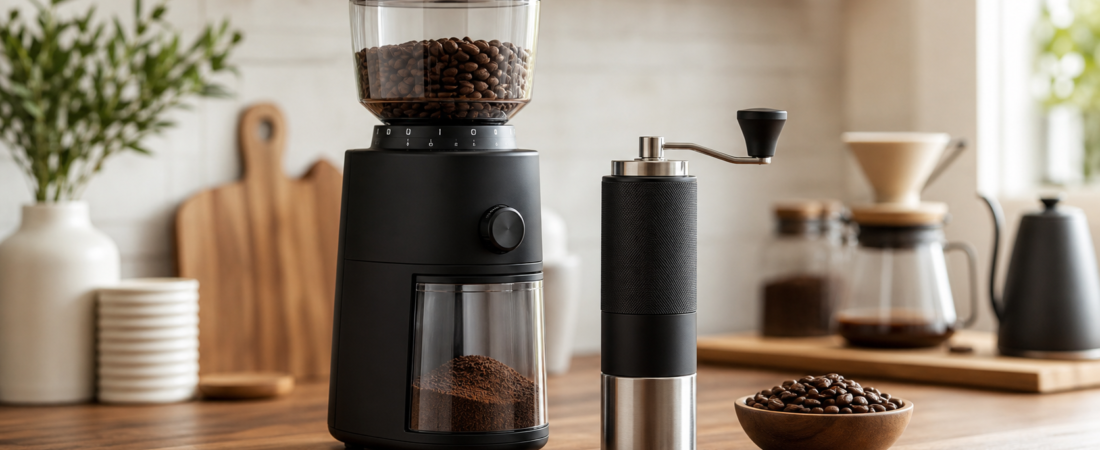
A good coffee grinder can improve your morning coffee more than many expensive brewing accessories. Freshly and consistently ground beans help produce a balanced cup, whether you use a drip coffee maker, French press, pour-over brewer or espresso machine.
You also do not need to spend hundreds of dollars to get started. The best coffee grinders under $100 provide adjustable burrs, useful grind settings and better consistency than an ordinary blade grinder.
Our top recommendation for most people is the Capresso Infinity Conical Burr Grinder. If grind quality matters more than speed, the Timemore Chestnut C3S is an excellent manual alternative.
Price note: Product prices and availability can change. Confirm that a grinder remains below $100 before purchasing.
Best Coffee Grinders Under $100 at a Glance
| Coffee grinder | Type | Best for | Check the price |
|---|---|---|---|
| Capresso Infinity | Electric conical burr | Best overall | Amazon Price |
| Timemore Chestnut C3S | Manual conical burr | Best grind quality | Amazon Price |
| Timemore Chestnut C3 ESP | Manual conical burr | Best for espresso | Amazon Price |
| Cuisinart Supreme Grind DBM-8 | Electric burr | Best for convenience | Amazon Price |
| Hamilton Beach 80382 | Electric burr | Best budget option | Amazon Price |
1. Capresso Infinity Conical Burr Grinder — Best Overall
The Capresso Infinity is our best overall choice for shoppers who want the convenience of an electric grinder without exceeding $100.
It uses commercial-style conical steel burrs and a gear-reduction motor designed to grind slowly. A slower grinding process can reduce heat and help preserve the aroma of the coffee beans.
The Infinity covers the common grind range needed for French press, drip coffee and pour-over brewing. Its removable upper burr also makes routine cleaning easier.
Advantages
- Conical steel burrs
- Simple timer control
- Suitable for several brewing methods
- Removable upper burr
- Relatively quiet operation
- Convenient for daily use
Disadvantages
- Limited precision for dialing in espresso
- Plastic construction on the most affordable version
- Grounds can sometimes cling to the container because of static
Best for
Choose the Capresso Infinity if you want an easy-to-use electric grinder for drip coffee, pour-over or French press.
Check current price: Amazon Price
2. Timemore Chestnut C3S — Best Manual Coffee Grinder
The Timemore Chestnut C3S is the best option for coffee drinkers willing to grind by hand in exchange for better grind quality.
It features 38 mm CNC-machined stainless-steel conical burrs supported by a dual-bearing system. Its aluminum-alloy body feels more substantial than the plastic construction found on many inexpensive grinders.
The standard C3S has a capacity of approximately 20 grams, making it suitable for one or two cups at a time. Timemore lists settings covering espresso through French press, although the standard adjustment dial is better suited to filter coffee than precise espresso dialing.
Advantages
- Consistent grind quality
- Stainless-steel conical burrs
- Durable metal body
- Compact and travel-friendly
- No electricity required
- Suitable for multiple brewing methods
Disadvantages
- Requires manual effort
- Small capacity
- Grinding several servings takes longer
- Standard adjustment dial offers limited espresso precision
Best for
Choose the Timemore C3S if you make pour-over, AeroPress or French press coffee and prioritize grind quality over electric convenience.
Check current price: Amazon Price
3. Timemore Chestnut C3 ESP — Best Under-$100 Grinder for Espresso
Finding a capable espresso grinder below $100 is difficult. Espresso requires small and precise adjustments, and most inexpensive electric grinders do not provide enough control.
The Timemore Chestnut C3 ESP addresses this problem with an adjustment dial intended for finer espresso calibration. It retains the portable design and stainless-steel burr system of the C3 family but provides more control when dialing in an espresso shot.
Because it is manually operated, it requires more effort than an electric grinder—particularly with light-roast beans. Nevertheless, it is a sensible starting point for espresso drinkers with a strict $100 budget.
Advantages
- Finer adjustment increments for espresso
- Stainless-steel conical burrs
- Compact metal construction
- Also usable for filter coffee
- Better espresso control than most budget electric grinders
Disadvantages
- Manual grinding requires effort
- Small bean capacity
- May take time to find the correct espresso setting
- Price can occasionally exceed $100 depending on the configuration
Best for
Choose the C3 ESP if you need an affordable grinder for a non-pressurized espresso machine and do not mind grinding manually.
Check current price: Amazon Price
4. Cuisinart Supreme Grind DBM-8 — Best for Convenience
The Cuisinart Supreme Grind DBM-8 is a convenient choice for households that prepare several cups of coffee at once.
It provides 18 grind positions, an eight-ounce bean hopper and a cup-selection control covering four to 18 cups. The grinder stops automatically when its timed cycle finishes, making it easy to use during a busy morning.
Its large grounds chamber can hold enough coffee for multiple servings. However, grinding a fresh portion immediately before brewing usually produces better results than storing a large amount of ground coffee.
The DBM-8 is most suitable for ordinary drip coffee and French press. Although its finest setting is labelled for espresso, it does not provide the precision normally required for dialing in a non-pressurized espresso basket.
Advantages
- Electric operation
- 18 grind positions
- Large hopper and grounds container
- Automatic shutoff
- Removable components
- Simple cup-selection control
Disadvantages
- Louder than many conical-burr grinders
- Less consistent than a quality manual grinder
- Not ideal for demanding espresso preparation
- Can produce some static and fine coffee particles
Best for
Choose the Cuisinart DBM-8 if you regularly make several cups of drip coffee and want an affordable electric burr grinder.
Check current price: Amazon Price
5. Hamilton Beach 80382 — Best Budget Coffee Grinder
The Hamilton Beach 80382 is one of the most affordable ways to move from a blade grinder to an adjustable burr grinder.
It provides 18 grind settings and lets users select an amount between two and 14 cups. The hopper can hold approximately two cups of whole coffee beans, while the upper grinding wheel can be removed for cleaning.
The grind consistency will not equal that of a more expensive conical-burr or quality manual grinder. However, it offers useful convenience for casual coffee drinkers who primarily use an automatic drip machine.
Advantages
- Very affordable
- 18 grind settings
- Two-to-14-cup selector
- Removable upper grinding wheel
- Automatic operation
- Cleaning brush included
Disadvantages
- Basic construction
- More variation in particle size
- Not recommended for serious espresso preparation
- Likely to produce more noise and static than premium grinders
Best for
Choose the Hamilton Beach 80382 if price is your main concern and you need a basic grinder for an automatic drip coffee maker.
Check current price: Amazon Price
How to Choose a Coffee Grinder Under $100
Choose burrs instead of blades
A blade grinder chops beans with a fast-spinning blade. This can create a mixture of large pieces and fine powder.
A burr grinder crushes beans between two grinding surfaces, generally producing more uniform particles. Consistency helps water extract flavor from the coffee more evenly.
For that reason, every primary recommendation in this guide uses a burr-based grinding system.
Decide between manual and electric
An electric grinder is faster and more convenient, particularly when preparing coffee for several people.
A manual grinder puts more of the budget toward the burrs and construction instead of a motor. It can therefore provide excellent grind quality for the price, but grinding requires time and physical effort.
Choose electric for convenience and larger batches. Choose manual for portability, quieter operation and potentially better grind quality on a limited budget.
Match the grinder to your brewing method
Different brewing methods require different grind sizes:
- Espresso: fine
- AeroPress: fine to medium
- Pour-over: medium-fine
- Automatic drip: medium
- French press: coarse
- Cold brew: coarse
A grinder marketed as suitable for espresso may not necessarily provide the tiny adjustments required by an unpressurized espresso basket. Under $100, a manual espresso-focused grinder is generally a safer choice.
Consider capacity
A 20-gram manual grinder is sufficient for approximately one or two cups. A large electric hopper is more convenient for a household or office preparing a full pot.
For maximum freshness, avoid leaving beans in the hopper for long periods. Store unused beans in an airtight container away from heat, moisture and direct sunlight.
Look for easy cleaning
Coffee oils and fine particles accumulate inside a grinder. Removable upper burrs, accessible chambers and an included brush can make maintenance easier.
Never wash burrs or place grinder components in a dishwasher unless the manufacturer’s instructions specifically say that it is safe.
Our Verdict
The Capresso Infinity is the best coffee grinder under $100 for most buyers because it combines electric convenience, conical burrs and a useful range of settings.
For the best grind quality without exceeding the budget, choose the Timemore Chestnut C3S. Espresso drinkers should consider the Timemore C3 ESP, while shoppers seeking the lowest possible price can start with the Hamilton Beach 80382.
Whichever model you choose, grinding beans shortly before brewing is one of the simplest ways to make fresher and more flavorful coffee at home.
Frequently Asked Questions
Is a $100 coffee grinder good enough?
Yes. A grinder below $100 can work well for drip coffee, French press, AeroPress and pour-over brewing. Manual models can provide particularly good grind consistency for the money. Serious espresso preparation may require either a specialized manual grinder or a larger budget.
Is a burr grinder better than a blade grinder?
A burr grinder generally produces more uniform coffee particles than a blade grinder. This supports more even extraction and makes it easier to repeat a successful recipe.
Can an inexpensive grinder make espresso grounds?
Some inexpensive grinders can grind finely, but fineness alone is not enough. Espresso also requires precise adjustment and consistent particle size. A manual espresso-focused grinder, such as the Timemore C3 ESP, is usually preferable to a low-cost multipurpose electric grinder.
How often should I clean my coffee grinder?
Brush loose grounds from the grinder every one or two weeks if you use it daily. Perform a more thorough cleaning approximately once a month, following the manufacturer’s instructions. Dark, oily beans may require more frequent cleaning.
Should coffee beans be stored in the grinder hopper?
Only store a small quantity in the hopper if you will use it soon. For longer storage, keep beans in a sealed, opaque container in a cool and dry location.
Affiliate disclosure: This article may contain affiliate links. If you purchase through these links, we may earn a commission at no additional cost to you.